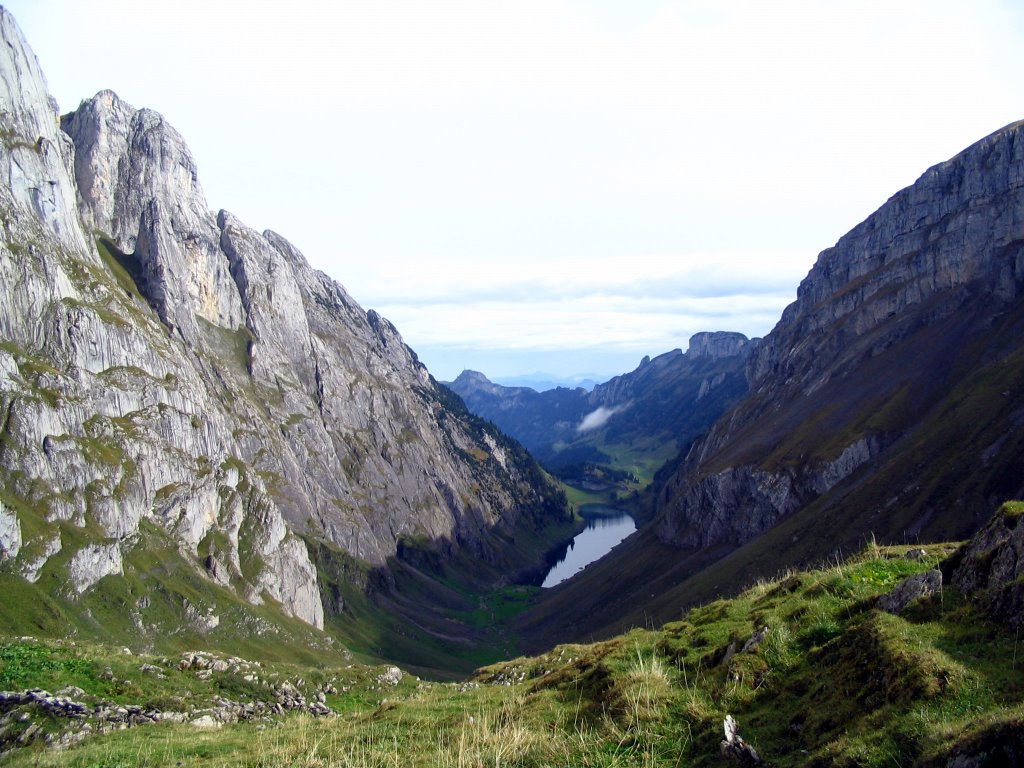
 Looking at this picture of the Fälensee, the first thing you must be wondering it why the lake is so much darker than any other body of water you've ever seen. Well, like many other mind-boggling natural phenomena, this one has a very interesting and accurate story behind it.
It all begins with a simple farmer, who was grazing his cows by the shores of the Fälensee on a warm summer’s evening. As he strolled around the clearing, doing whatever it is farmers do while their livestock are feeding, his mind turned to questions theological.
“God - ha! Don’t believe in him one bit!” declared the farmer to himself. “For I am an atheist.”
Little did he know, in the stillness of the Alpstein mountains there was somebody listening to his rash words – somebody called God. “An atheist, eh?” pondered the Almighty. “Well I can’t have that! That’s why I’m going to take out my rage on the real culprits: those vile cows.”
And it was about that time that God began hurling targeted lightening into the valley, which not only killed the cows instantly, but had the additional effect of picking up their bodies and depositing them in the lake. Troubled by this sudden development, the farmer ran down from the mountains and told his story to a number of credible historians, who set down a true account of it for all posterity.
Meanwhile, the bodies of the wicked cows sunk slowly to the bottom of the Fälensee. And since, as everyone knows, there is nothing blacker than the electrocuted cow-corpse of an unbeliever, the formerly pearl-white lake became quite the darkest little pond in all the world.
 One of many memorials commemorating Switzerland’s valiant participation in World Wars Eins & Zwei.
 Grown men bicker like children at an impromptu public chess game in Geneva. Even on rainy days, these Titans’ battles draw sizeable crowds.
 Perhaps the best feature of direct democracy in Switzerland is that no town, however small, ever suffers from short supply of partisan posters. As a fearmongering device, rampaging dinosaurs are actually pretty tame: a group opposed to a proposition to increase workers’ benefits is currently decorating Lausanne with pictures of cackling witches and werewolves menacing small children.


