July 27, 2006
When I was five years old, my kindergarten teacher contacted my mother with bad news.
“Nicholas is a very
different child,” Mrs. Ross confided. “I think he’s the most
different child I’ve ever seen in my 20 years of teaching.”
She then invited my mother into the class to observe what she meant. In one particularly memorable demonstration, which has ever since been one of my parents’ most cherished anecdotes, she assembled the class on the floor, and then told us to go back and sit at our desks. Everyone did so, with one exception. I remained slack-jawed on the carpet, gazing out the window, dumb as an old tin bucket.
“Perhaps he’s iron-deficient,” my teacher offered hopefully.
Alas, medical tests soon shattered this charitable hypothesis, and poor Mrs. Ross was left shaking her head. “He’s just so
different,” she offered at last. “He’s not on the same level as the other students. He doesn’t seem to grasp what’s going on around him. I’ve seen nothing like it in my 20 years of teaching.”
It’s hardly an auspicious start to be ranked not only the most retarded child of a class, but of an entire career. Still, having managed to get through the first 22 or so years of my life without swallowing more than the average number of shiny objects, I had begun to nurture hopes that Mrs. Ross’ grim prophesies were misguided. Would I be able to live a full life just by trying hard and being myself, as Arthur the Aardvark promised me every afternoon?
As it turned out, no! This summer, I found myself reduced once more to a simple-minded state – and yet again there could be no blaming the problem on a lack of iron. But almost: this time my deficiency was in German.
Now, like any other freedom-loving patriot, I grew up thinking of the German language less as a mode of a communication than as an available feature to add colour to a villain, like a rakish sidekick or a disfiguring scar. So it was difficult, when I first arrived in Switzerland, to actually contemplate learning to speak this rude tongue myself. At Deborah’s extended family reunion, rather cruelly scheduled for three days after our arrival, I only smiled affably and chuckled when barked at. And if any of the myriad aunts and cousins had been instructing me to go sit to my desk, I would have been blissfully unaware.
But very quickly my lack of German knowledge began to have dire consequences. And while it’s true that harping on about charming linguistic misunderstandings is a staple of very bad travel writing, it's also true that I have never pretended to rise above this level. In any case, one debacle occurred when I was trying to explain to some Swiss people the workings of a traditional Swiss game that Deborah had taught me to play in Vancouver. The game consists of two people rapping a couple of hard-boiled eggs against each other while chanting pagan doggerel (this being what the Swiss were doing when the rest of Europe was building mighty empires). I had expected my listeners, being Swiss, to recognize what I was talking about immediately, but I hadn’t counted on my exceedingly poor command of the language. What I had thought meant “tapping eggs together” actually meant “striking testicles”, which won me some strange glances from my listeners as I gushed about how quaint I found this supposed staple of their culture.
A more troublesome misunderstanding occurred a bit later on a train running through central Germany. The conductor twice favoured me with a stern lecture whose only intelligible word was “wagon,” so I assumed I was sitting in the wrong car and got up and moved. Joke’s on me! Turned out she was saying that the train was about to separate in half, and both my wagon and I were shipped off to an end-of-the line station in east Bavaria, where I had plenty of time to ponder the curse of Babel while I spent the night in a ditch by the station.
The only really successful German conversation I have had so far was with Deborah’s wunderbar grandfather, Ernst. After an indecipherable preamble, he told me I had beautiful teeth. I told him he had beautiful hair. We parted as friends.
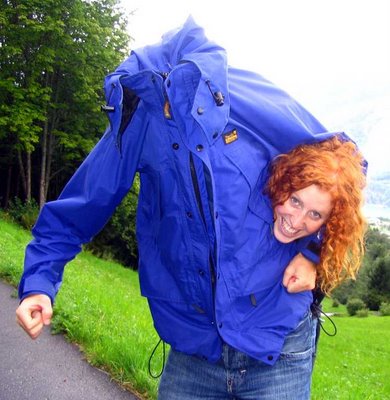 Deborah and I put on tricks to confound the local villagers in Glarus, site of Europe's last execution for witchcraft.
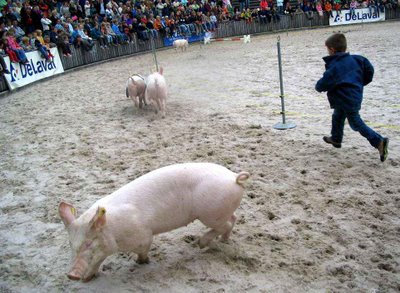 Fleet-footed swine and a confused child strut their stuff at the races at Olma Fair, St. Gallen. In Switzerland, pigs are raced for entertainment and high-stakes gambling, while horses are carved up into sausages for human consumption. Furthermore, cows are entered into national beauty contests that everyone seems to take very seriously.
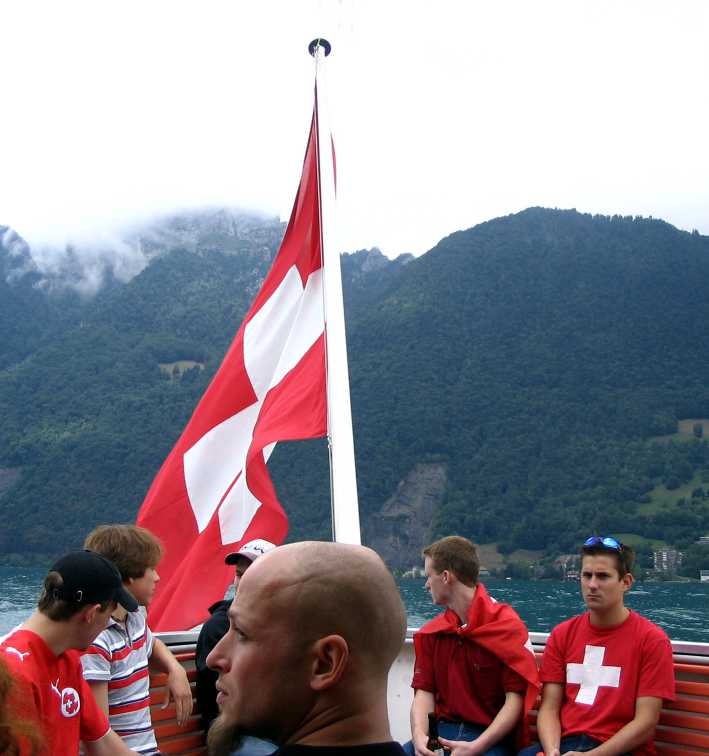
  An age-old Swiss tradition in Rütli: waving red flags to scare away prospective immigrants.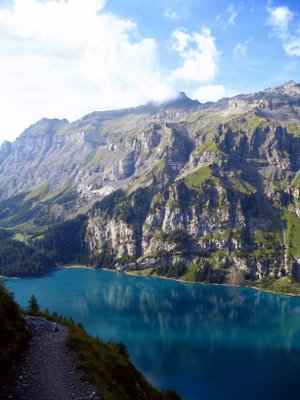



 Sometimes an eight-foot-long phallic wind instrument is just an eight-foot-long phallic wind instrument: alphorn players celebrate Swiss nationhood with a venerated stereotype.
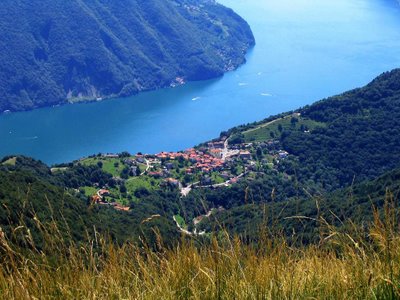 Combining Italy's sun and scenery with Switzerland's capacity for running a country that isn't a flagrant embarassment to the European continent, Il Ticino is probably the best place in the world.